


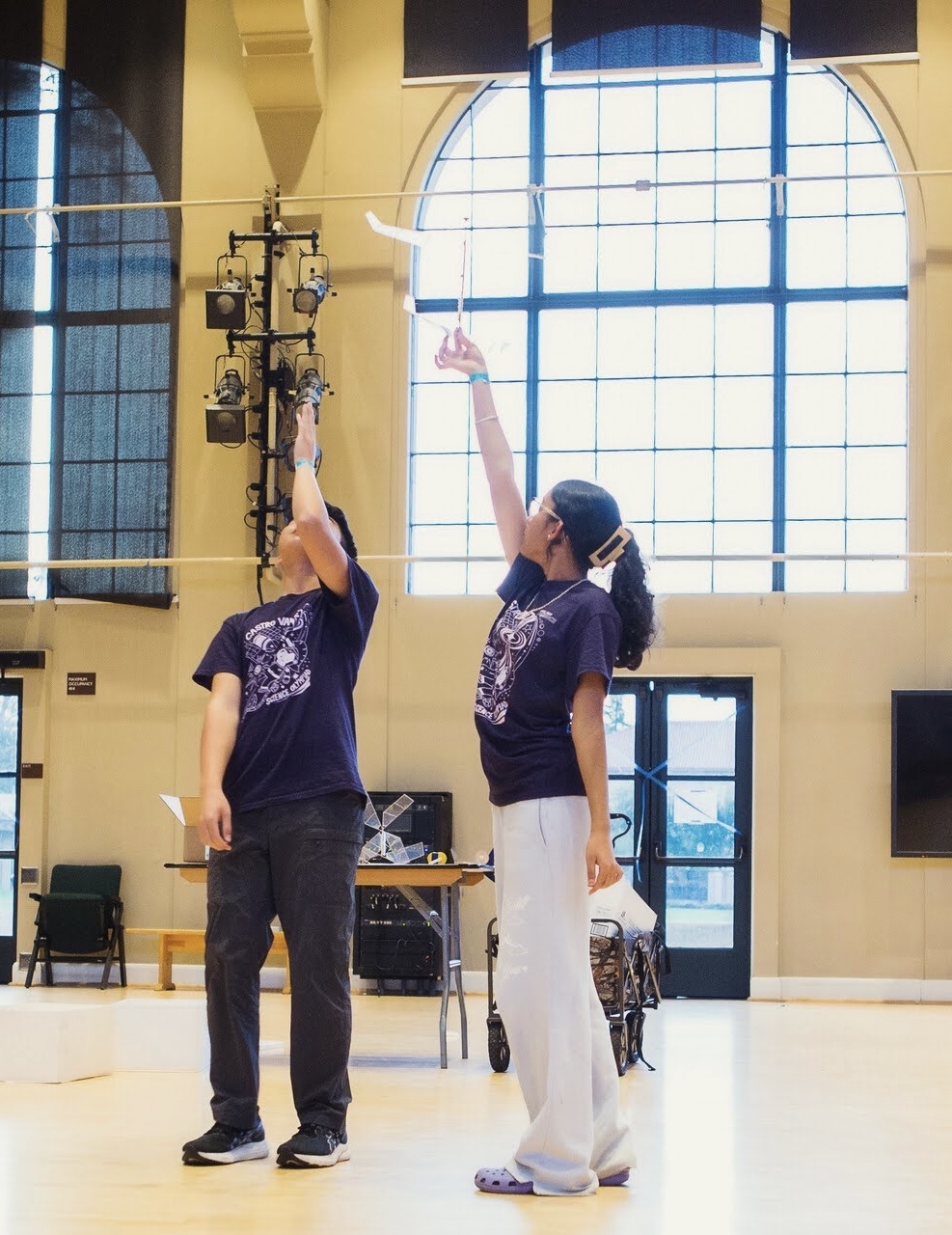
Entering California State University, Yashika Pathak felt a mix of excitement and pressure, knowing that she was going to compete against 90 other teams each representing their own school. The accumulation of months of preparation and studying had led to the big moment. Unlike the other tournaments she had competed in, this was one of the most competitive tournaments, as it was a state-wide tournament hosted by Science Olympiad (SciOly) on Jan. 31, 2025.
Pathak has been doing SciOly for 4 years since middle school. She deeply enjoys the combination of working collaboratively and studying science with her teammates. Furthermore, it allowed her to explore different areas of science that she normally wouldn’t learn at school.
“It has introduced me to areas of science that I genuinely became interested in, especially biology, anatomy, microbiology, and genetics,” said Pathak.
Prior to the competition, Pathak had spent a handful of time studying anatomy and creating a cheat sheet for Anatomy and Physiology. In addition to that, she practiced different types of codes for Codebusters, preparing and testing her helicopter, and learning microbiology concepts for Microbe Missions. In the week before the final, she met up with all her partners to finalize cheat sheets, builds, and study, ensuring that they were all prepared.
“These four events required different skills, which include memorization and application of scientific concepts, logical problem-solving, engineering and experimentation, and microbiological knowledge,” she said. “Because of that, I couldn’t prepare for the entire tournament in one way. I had to constantly switch between different ways of thinking.”
The first event she competed in was anatomy and physiology. In this event, she needed to have a deeper understanding of the structures and physiological processes that connect to each other. This event consisted of challenging problems, free response questions, and unfilled diagrams/charts that were to be completed within 50 minutes.
The next event was codebusters. Instead of relying on knowledge, she had to utilize logic, pattern recognition, mathematics, and problem solving to decode given ciphers. This was not a solo event, however; it required her and her partner to communicate efficiently, divide up problems, and recognize which methods worked better.
Codebusters had ended and up next was the helicopter. Rather than studying, memorizing, and doing practice tests like the previous events, this one required her to work with a balsa wood in order to create a helicopter. Using the creation, she swung it forward in order to make it fly. Throughout the event, she constantly had to think about possible factors that could affect the flight. Possible factors included the rubber band breaking and instability, which may lead the helicopter to fall and be destroyed.
Lastly was a microbe mission in which she was required to have a deep understanding of microorganisms and concepts that relate to it. Similar to anatomy, she completed a set of questions, filled in blank charts/diagrams, and answered free response questions while having only 50 minutes to complete all of it.
“I placed ninth in anatomy and physiology, fourth in codebusters, seventh in helicopter, and sixth in microbe mission. Seeing those results were incredibly satisfying because each placement represented a different kind of preparation,” she said.
These placings were high, considering the fact that she was up against 90 other teams. Pathak earned two gold medals and was ranked within the top ten in all four events. These results made her feel triumphant of herself and her teammates who she worked along with. The hours of dedication and diligence were finally worth it at the end of the road as it allowed her to achieve the outcomes she had hoped for from the start.
