Blog

  • Deadly algae bloom kills three dogs at Lake Chabot

    Deadly algae bloom kills three dogs at Lake Chabot

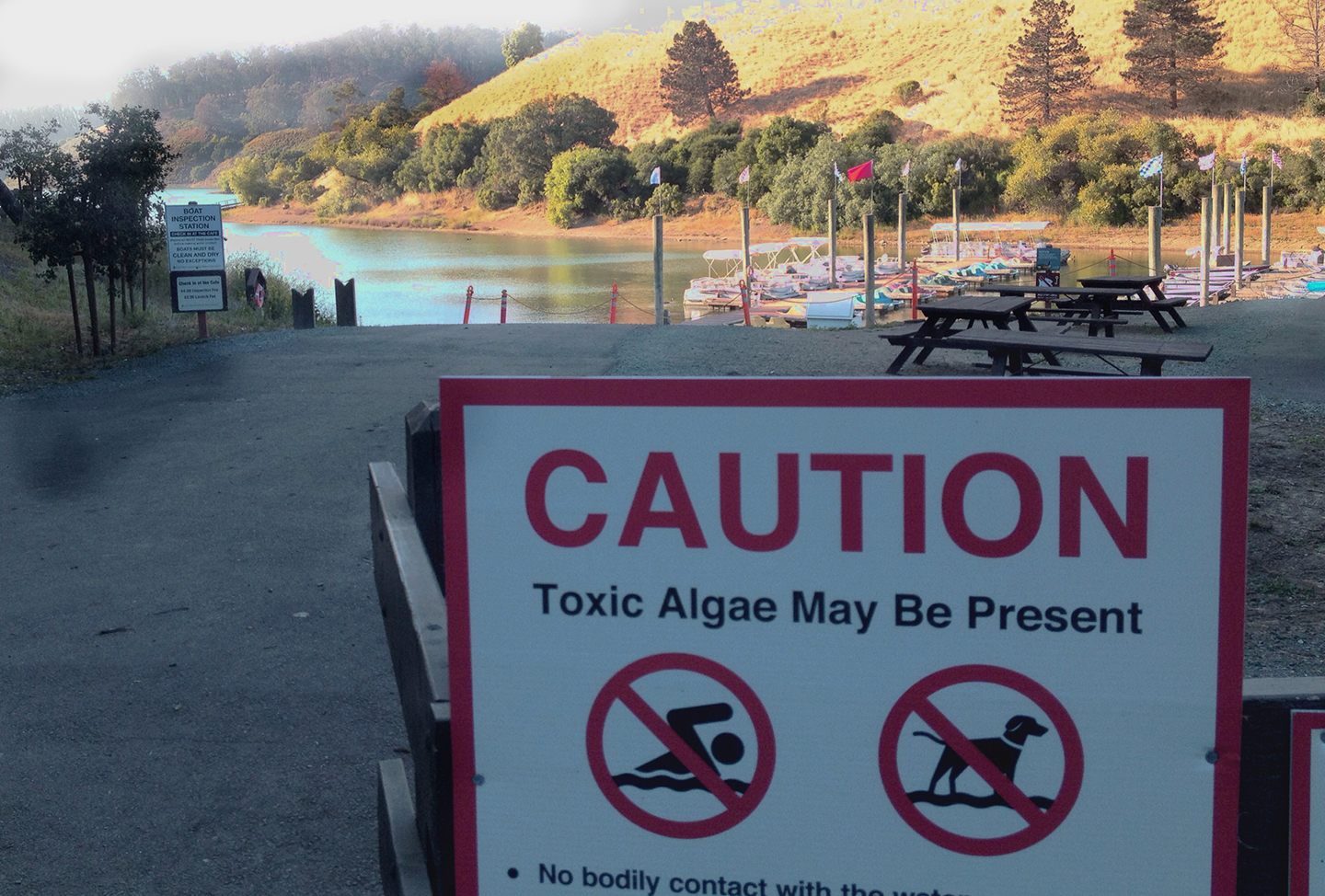
    Three dogs have died due to a poisonous algae bloom that has been growing in Lake Chabot since around September of 2014. The toxic algae is still in Lake Chabot, so be cautious with dogs and small children while near the lake.

    Algae bloom is defined as a rapid increase or growth of algae in a water system and mostly occurs in freshwater and marine environments. Algae blooms can be caused by warm, slow-moving waters that are rich in nutrients. Blooms can occur at any time, but are most common in late summer or early fall. The type of algae bloom found in the lake is cyanobacteria, also known as blue-green algae blooms, which in some cases can carry harmful toxins.

    According to the East Bay Regional Park District, the toxins in the algae are most likely due to the drought.

    “Because we haven’t had a lot of rain, the stagnant lake is perfect conditions for algae growth,” said Carolyn Jones, the park district spokesperson.

    There have been reports of the toxic algae in other lakes around the state as well. The park district strongly recommends that people and dogs should not make any contact with the water in Lake Chabot. Mild exposure can cause slight side effects, but high levels of exposure can lead to serious illness, or, in some cases, death.

    “The solute to solvent ratio in most freshwater is high, but with the drought the amount of solvent water decreases, leaving more of the solute in the water possibly increasing the toxins,” said AP Environmental Science teacher Nathan McCreary.

    McCreary also speculated about how poisonous the toxins could be in order to kill dogs.

    “To kill a large dog would take a lot [of toxins], maybe if the dogs drank the water, the type of toxin can’t be easily broken down by the stomach acids. They could be neurotoxic,” he said.

    McCreary agrees with the park district and believes that the sudden growth of the blue-green algae is most likely due to the drought in California, stating, “The statewide problems with the toxic algae are most likely a by-product of the drought.”

    The algae in Lake Chabot could be here for a while.

    “We are letting nature run its course. Because Lake Chabot is such a large lake and is a backup water supply for emergencies, we don’t want to chemically treat it,” said Jones.

    When asked about what the park is doing to warn people, Jones replied, “We are trying to get it all over the Internet. We also posted a bunch of signs, and we have staff on site to verbally warn people. On busy weekends we will send extra staff in boats on the lake to make sure that everyone is safe.”

    Jones also made it very clear that dogs and people should not be in Lake Chabot anyways because it is a water reserve.

    Hopefully with more rain the algae will go away, and Lake Chabot will be restored to its former glory.


  • Spanish act plays with emotions of students

    One of the fun and exciting things that the Spanish 4 classes get to do is act in a short play that explains the traditions of Christmas and New Year’s that occur in Spanish-speaking countries.

    The play is usually around ten minutes. Each Spanish 4 student receives lines to memorize and usually some fun props like signs, a cake, a piñata, or even grapes that go along with part of the play. After memorizing their lines, the students go into multiple classrooms the week before winter break and present their plays to the different classes.

    Luckily the play is in English, so classes that are in a lower level of Spanish and other languages can be enriched with Spanish culture. For the students in the Spanish 4 classes, it’s a fun way to learn about the traditions and spread knowledge to others. It is also fun for the Spanish 4 students to work together on the play, creating a sense of community in the class.

    “I think it’s surprising to students to learn about how varied the celebrations are,” said Spanish teacher Laurel Orduña.

    One difference between American and Latino cultures is that in the U.S., Santa Claus is a jolly man who comes through the chimney to deliver presents for all of the good children, but in Spanish-speaking countries, Viejo Pascuero comes through the window to deliver his presents.

    This merry Christmas play helps bring culture and new traditions to CVHS.

  • Renaissance program coming back to CVHS

    Renaissance is returning to CVHS! Leadership is bringing back the grade reward system after four years of being absent from CVHS. A group of leadership officials in the Renaissance Committee have decided to create a new Renaissance program that includes amazing prizes for the students that qualify.

    Although the Renaissance Committee members are still working out details, they have determined that the qualifications for Renaissance will be based on grade point average (GPA) with three different qualification sections and one qualification section for GPA improvement. Some of the prizes for the qualifying students could be t-shirts or booklets. They are also working on the expansion of Renaissance so it will continue to reward students throughout the school year instead of over one semester as Renaissance did four years ago.

    ASB Treasurer Jessica Yin campaigned last year for the Renaissance program to come back to CVHS.

    “If you look at our activities program, we don’t have any kind of program to award academic achievement, which I think is really important,” says Yin. “It will be nice for the students of CVHS to be rewarded on their academic excellence and be encouraged to work harder to improve their GPAs and be the best that they can be.”

    In words of encouragement to all students, Yin says, “Renaissance is not just for top students. Improving your GPA is just as important as maintaining a high GPA. Renaissance is a program to offer real, tangible rewards as you make your way towards a long term goal for the future.”

    Nicholas Whitaker, leadership advisor, also talked about the new Renaissance program. According to Whitaker, Renaissance will most likely start next year and the leadership team will be trying to get local businesses to participate, possibly providing some of the prizes, since the Renaissance program has no funding.

    “The leadership team is doing their best, it’s completely run by them which requires extra work to help reward students,” says Whitaker. “It’s definitely something we regretted getting rid of, but we are excited to bring it back because students deserve rewards for outstanding achievement.”

    Hopefully by this time next year CVHS will be reunited with Renaissance.

  • New menu leaves students hungry for change

    New menu leaves students hungry for change

    The CVHS cafeteria has decided to get healthy by serving better food options at breakfast and lunch. Things like sugary treats and drinks are a thing of the past, as the cafeteria staff works hard to provide healthier options for all students.

    “I’m expecting new and better quality,” said cafeteria staff member Ana Aguilar. “I expect more students to come in and enjoy what the cafeteria has to offer.”

    Not only has the cafeteria food changed, but options across campus are different as well. The vending machines that stood outside of 700, 200, and 600 halls are gone.

    “The vending machines had unhealthy snacks that were not healthy for our students, so we are trying to provide healthier snacks at the snack bars for the students,” Aguilar said.

    Along with the new menu, CVHS has hired a new cafeteria staff for the 2014-2015 school year.

    “I want to make a happy and fun environment for my coworkers,” Aguilar explained. “And I encourage them to be friendly to the kids, because these kids are my kids.”

    Senior Christopher Baker has other opinions about the healthy lunches.

    “Well, the lunches are boring,” Baker said. “I want healthier lunches, but why can’t they taste good too?”

    In fact, many students are disappointed about the new menu. “I really want them to bring back bigger breakfast portions,” said senior Amelia Ortiz. “These small sandwiches don’t really fill me up at all.”

    The recent changes in portion size are due to the Healthy Hunger-Free Act, a federal program which focuses on reforming child nutrition. The shift in the cafeteria menu started last school year, upsetting many CVHS students.

    Junior Chris Phongsa started a petition in the spring in response to the changes.

    “Since this act was enforced by our new director of Nutrients and Foods, our food portions have become smaller, while still regulating the previous price of $3,” said Phongsa. “The purpose of the petition is to ensure a larger food portion—a larger range of foods and snacks to be picked from…more nutritious foods, and better quality of the foods served.”

    The petition received over 600 signatures.

    Despite the critiques, Aguilar believes that these new changes to CVHS cafeteria is the key to a better school year. “If you eat healthy food, and eat a healthy breakfast on time, you will be ready to learn and be successful,” she said.

  • Chromebooks replace computer labs

    Chromebooks replace computer labs

    The computer labs in the 300 and 700 halls have been closed down and four Chromebook carts have taken their place. The two former labs now stand as classrooms.

    Although having the four carts instead of just two labs would ideally improve the competition for computer time, other issues have now arisen.

    One such difficulty is transporting the carts through crowded hallways.

    “Labs have to be moved if they’re mobile. They may have to get across campus by the next period,” said Assistant Principal Jesse Hansen.

    A solution for this is to space out the location of the carts around campus so teachers will be able to sign up for the cart nearest them. Some possible locations for the carts are the 100 and 300 halls and two in the 700 hall.

    The Chromebooks are definitely more updated than the computers in the labs were, and students can even connect to the school’s wireless network on them, but they lack printing capabilities. It’s possible for students to share and turn in documents via Google Docs, but it’s a hassle for teachers who need hard copies of their students’ work.

    “One of the issues that have been stressing English teachers out is they can’t hand edit or peer review documents shared in Google Docs. They’d have to print them all out,” said Hansen. “In the long run, as we move away from paper, it’ll be easier.”

    According to Hansen, copying and printing is one of the school’s highest expenses.

    A benefit to the Chromebook carts is that there are now more computers available for students. Each cart carries around 36 Chromebooks, and with four of those plus the media lab, which is still in use, it has been slightly easier to sign up for them.

    “The idea is to get every student a computer. Eventually everyone can have their own,” said teacher Jeffrey Goldstein.

    “The Chromebooks are really cool. I love how teachers are willing to incorporate computers into learning, something that will inevitably be done because of this technological revolution,” said senior Carmen Hom. “It immediately makes everyone more interested in the activity.”

  • Dress code enforcement enrages students

    Dress code enforcement enrages students

    This year at CVHS, things are a little bit different. The lunch lines have changed, the trees in the courtyard are still littered with toilet paper from last year’s senior prank, and there’s been a shift in administration. One big change to the school this year, however, is the enforcement of the dress code.

    The dress code’s purpose, according to the student handbook, is to “promote a serious academic atmosphere and assure the physical and emotional safety of every individual.” Now, administrators are beginning a crack down on the dress code, including stronger consequences, and dress code sweeps.

    But with this change in enforcement have also come complaints. The assistant principals plan to perform dress code checks, which Assistant Principal Jesse Hansen describes as “taking a specific period of time when all the administrators would be available, and marking a few places on campus to catch anyone out of dress code in that area, and then sending them to change and get warnings.”

    This change in enforcement is partly due to the belief among staff that the dress code has become lax in recent years, and is also due to a change in the administration of CVHS.

    While many teachers and staff seem to support the change, students and parents alike have complained about how the school is spending its time. Some parents believe the school should be focusing on education, instead of what students are wearing.

    Senior Sabrina Murugesu agrees. “I really don’t see why we need adults telling us what and what not to wear. It doesn’t affect how I do in school, and sometimes it’s really hot out,” she said.

    Consequences for dress code violations range from calls home to family to detentions.